Monday, March 18, 2013

My Integrity and Yours


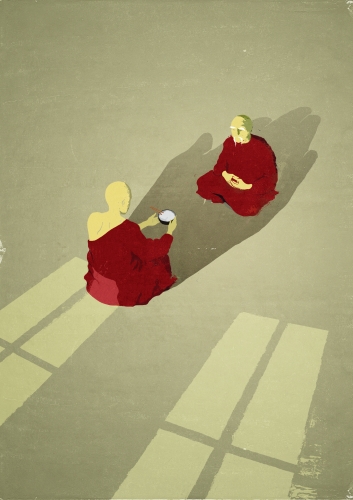
Picture courtesy of The Tricycle Newsletter


Character building starts with having integrity; to act according with a sense of what is right or wrong, good or bad, permissible or impermissible.  
You and I will never be sorry: 
For thinking before speaking,
For hearing before judging,
For forgiving your enemies,
For being candid and frank,
For helping a fallen friend,
For being honest in business,
For thinking before acting,
For being loyal to your monastery,
For standing for your principles,
For bridling a slanderous tongue,
For stopping your ears to gossip,
For harboring only pure thoughts,
For sympathizing with the afflicted,
For being courteous and generous to the needy,
For being kind to ALL!

Wednesday, January 23, 2013

My Barriers in Teaching and Learning


                                          Paññāsāstra University of Cambodia


Since I consecrate my life teaching the children, I find real satisfaction on sharing constructive criticism for the betterment of our new generation.  Teaching is one of the supreme fulfillments of my ‘generativity’ stage (Erikson's seventh developmental lifespan stage) in which my primary concern is to help develop the younger generation to gain the necessary knowledge, experience, understanding, and competencies to lead a useful life.  But I learn early that I can’t fix everything.  In the process, I encounter considerable hurdles. I would like to share my barriers in teaching and learning:
  1. In teaching and learning, I learn to enjoy uncertainty and become familiar with failure.  The word “study” has multiple meanings to my students.
  2. I need to understand who the students are, their motivation to learning.  It is not always possible to teach students who are not internally motivated.
  3. I face many challenges to continuously looking for innovative ways to enhance classroom management, lesson-implementation skills and rapport with students.
  4. The instructional style versus the learning style must be matched.  Develop interest in the subject, develop an engaging method of delivery and use other motivational issues play a bigger in successful teaching and learning.
  5. There are no seven habits of effective teaching, no five rules for pedagogic success.  The truth is that teaching is frequently a gloriously messy pursuit in which shock, contradiction and risk are endemic. 
  6. My life as a teacher often boils down to my best attempt to muddle through the complex contexts and configurations that my classrooms represent.
  7. Passion, hope, doubt, fear, exhilaration, weariness, colleagueship, loneliness, glorious defeats, hollow victories and above all the certainties of surprise and ambiguity.  These are teaching.
  8. Teachings means to situational and resolutely plow ahead assuming that standardized indicators of good teaching do exist and can be proven to be reliable and valid across multiple contexts.
  9. I find out there are no such things as having common standards of teaching and learning in multiple classroom settings. 
  10. Events happen to us, but experiences are constructed by us as we make sense of theses events.  Experience can teach us habits of bigotry, stereotyping and disregard for significant but inconvenient information.
  11. Sometimes the best way for me to help learners struggle with difficult subject matter is not to offer them help but to let them work through these alone.  It requires patience, and it is time consuming.
  12. Some of the major dilemmas and complex uncertainties, such as how to strike the right balance between being supportive to students and challenging them with tasks they resist; how to create activities that simultaneously address all learning styles and racial traditions in a culturally and academically diverse classroom, exist in every institution.
  13. It is hard to imagine how can I make a difference in my students’ lives because every day circumstances force me to make a dazzlingly quick series of judgement about what to do next in class, how to respond to unforeseen events or how to translate a broad pedagogic or philosophical purpose into an immediate action.
  14. As a teacher, experiencing ego-deflating episodes of disappointment and demoralization is quite normal because even the most sophisticated practical reasoning cannot rid classroom life of its endemic unpredictability.
  15. I know I will never connect with everyone’s preferred learning style 100 percent of the time because of the diversity of my student’ personalities, experiences, learning styles, cultural formation, racial and cultural traditions and perceptual filters make that impossible.
  16. There is no universal truth in teaching; only personal truth that fits the situation I deal with everyday.
  17. I know that I will never be able to initiate activities that keep all students engaged all the times.
  18. There are no instantaneous successes.  Instead there has been an incremental building of recognition, confidence and success.  I have faith in the long-term victory.
  19. I know that making full disclosure of my expectations and agendas is necessary if I am to establish an authentic presence in a classroom.
  20. I know that I cannot motivate anyone to learn at a very basic level if they don’t wish to.  All I can do is try to remove whatever the pedagogic barriers that are in their way, and provide whatever modeling I can to build the best possible case for learning.
  21. Reading is a skill that all students must learn.  It is the single most important obstacle to academic success.
  22. The information I put in is easier than the information I pull out from the student’s head.  Repetitiveness will help.
  23. To enhance instruction, I must understand that learning is a cultural process invented for survival. Learning is about connecting based on time, frequency and importance of information to learner. Cells in neurons that fire together wire together.
  24.  Emotion is critical to teaching.  Emotional engagement can limit learning experience.  
  25. Best of all, I hope that as you read my words you will find that the truth which you are growing in teaching and learning is increasingly confirmed.


Friday, June 29, 2012

Taking Tests


All types of tests whether they are standardized, multiple choice assessment or performance assessments, are part of academic life.  Assessments are designed and used to monitor the university educational system for public accountability, evaluate instructional practices and teaching effectiveness, measure students’ achievement toward meeting standards and mastering skills.  Believe it or not, all students, lecturers and school administrators benefit from tests.  If administered and interpreted properly, tests gauge how well students are learning the skills and information their teachers have been teaching them.
Pannasastra University Students took English test
Many students fail their exams regularly because of many reasons such inadequate preparation, inappropriate study habits, poor planning, lack of motivation, laziness, anxiety, etc...    Here are some helpful hints to help those students improve their performance by understanding the two basic components in taking tests: the test itself (how difficult it is, how long, how fair, etc.), and you, as a student being tested (how much you’ve studied, how much you’ve prepared, how carefully you take the test, how ready you are, etc.…). The score you get represents a balance between these two variables.  The test might be hard, but if you're fully prepared, you'll do well. On the other hand, the test might be easy, but if you haven't kept up, it won't make much difference.  

In every academic course, the goal of the university lecturers is to facilitate your studying and provide the best context and methods for successful learning. In spite of this, not every one does well; some students simply decide not to study very frequently, and their performance shows it. Most of the instructors will do all they can to facilitate your learning, including designing the tests appropriately and carefully so that they reflect the study materials they have covered. The rest is up to the student. While the exams are fair, most of the time they are not easy, they require careful study and review throughout the course.  Here are four helpful advices to help students achieve a better result for their exams:
1.   Keep up with the course: this will mean doing the readings regularly, consistently and thoroughly, attending class all the time, and writing about the material learned in class. Of course, there is no guarantee that being a good learner will yield a high performance; always there are a few people who say, "I wrote my heart out, came to class every day, and studied constantly, and still I got a C on the test." Like it or not, there's more to doing well than just doing those things. Achievement means finding the most productive ways to learn the material, and that will depend in part on your own style and intellectual ability as a learner.
2.   Prepare for the exam: you'll want to review several sources of information: your class notes, the textbook/readings, your notebook responses, or information shared in a study group. Consider doing some of the followings: ask yourself questions as if you were an examiner, then try answering them. If you have trouble, you'll know where to go for clarification. 
Review your notes with an eye to comprehension, not just memorization. If you find yourself recognizing concepts immediately, that may feel great, but don't dwell on them too long; go on to those that make you feel less comfortable. 
  
Work in pairs or teams; find other people in the class and work through your review together. 
  
Make a list of everything you just can't seem to figure out; then you'll know where your weak areas are.  Ask about these.  As you work through them, keep crossing our your problem areas until you've eliminated most of what confuses you.
3.   Take the exam carefully: Half the battle is studying; the other is using what you've learned to help you take the test.  You might have studied very hard, but if you don't use good test-taking strategies, you may not do as well as you could.
4.   Review your exam when you get it back.  Be sure to go over your test, even if you did well, to keep using it as a learning tool.  You can never hurt to rethink questions.
Pannasastra University students took English test
Finally, students must remember those academic tests, exams, grades, and all the other difficult parts of learning are there by necessity to measure knowledge and determine students’ mastering of skills.  All tests of all sorts are part of the educational and academic system. They're not part of a conspiracy to hold the learners back. Without the student’s success, what good is the university lecturers’ instruction?  The bottom line is the students must also get involved in the learning process and take charge of their own learning.   Study hard and smart, stay interested and motivated (school is good for you), and please don't hesitate to consult the instructor about anything that concerns you.  Successful learning and passing the exams require strong commitment and a “can do” attitude. 

Sunday, January 1, 2012

These what I have learned in 2011…

As 2012 begins, these what I have learned in 2011…

About me
I have to “BE” first before I can “DO” and “DO” before I can “HAVE.”
I own my own life, mistakes and all.
I must endure to make any difference.
I am not free from criticism and blame.
I can create a better community little by little by passing ideas and skills to others.
I can’t be all things to all people.
I can’t fix everything but can help most things.
I teach who I am.
I help others to help themselves.
I simply can’t make good decision if I worry what others think.
I am the only one who can make my dream comes true.
I let go because everything is impermanent.
I've gotten to get out there and make my dreams happen. Dreams don’t just happen. They are the product of labor, hard work, and commitment.
If anything comes easily, it is not engender good worth.
If I can’t help 100 persons, I just help one today.
If I want people to be dedicated to me, I have to be dedicated to them.
Actions are always better than words.
Any greatness doesn’t come until I put in my own sweat.
Be kinder than necessary, for everyone I meet is fighting some kind of battle.
Don’t fight darkness. Bring the light, and darkness will disappear.
Forgiving, knowing that people do harmful things because they are unhappy.
Freedom is having a chance to be better.
It is possible to teach students who are not internally motivated.
It is when I forget myself that I do things that are remembered.
My life is more about giving than receiving.
Success is not the key to happiness. Happiness is the key to success. If I love what I am doing, I will be successful.
Time doesn’t heal all wounds. A part of me has died; that’s the way it is.
There is not secret to real success other than hard work, perseverance, and learning from failure.
Winning at all cost is to create more suffering and misery to others.
There is no situation so bad that I cannot be accepted patiently with an open accommodating heart and mind.

About Cambodia
Most people are tired of the dictates of one MAN.
The more people learn the freer they are (Liberationist Education).
True peace cannot be achieved unless poverty has been alleviated.
Everyone wants big rewards for not too much efforts and works.
False knowledge is more dangerous than ignorance.
Our present leader solves one problem only to create many more.
Justice is advantageous to the stronger.
The most basic tool available to the reconstruction of Cambodian society is the quality education of its children.
When the power of love overcomes the love of power, Cambodia will know real peace.
The tragedy of life is what dies in the hearts and souls of the vulnerable people of Cambodia while they live.
Nothing has changed much. I wish we could stand here today and say everything is moving forward. It is not. The “Money Is Everything” can be seen and felt in Cambodia. The government doesn’t provide the basic needs to the people.
This is the voice of one Cambodian woman on good governance: “A good government is a government that does not abuse the people, that gives the people the land back, and that allows people to earn a living.”
The fact that we have schools doesn’t mean we have education. The fact that we have pagodas doesn’t mean we have faith. The fact that we have courts doesn’t mean we have justice and egalitarian law. The fact we have functioning government doesn’t mean we have democracy.
There comes a point where I have to accept that the system is not working. The land grabbing is only the latest example of the state’s struggling to meet the needs of its citizens, needs as basic as providing water, housing, health care, and education.
Influential people and high-ranking officials have the ‘license’ to pursue their own desires regardless of the consequences.
What powerful people say will always be right, and what the weak say will be wrong. Justice is the interest of the stronger, not the weaker.
We can succeed if our leaders can give up their “Position Power” and keep their “Personal Power.”
We needs millions of dollars from domestic and foreign investors, but endemic corruption, red tape, and an unpredictable legal system all serve as deterrents.
Today if all the children of Cambodia are provided with primary health care, good nutrition, quality basic education, access to safe drinking water and sanitation, and the protection from neglect, abuse, and violence, 10 years down the road, Cambodia society will be completely different from being today.
Thursday, November 3, 2011

D.E.A.R. Campaign at Paññāsāstra University of Cambodia


D.E.A.R. Campaign at Paññāsāstra University of Cambodia
“Reading is a basic tool in the living of a good life.” ~ Mortimer Adler

D.E.A.R. stands for Drop Everything And Read. D.E.A.R. Campaign started in early March of 2011 after several groups of students from my Cultural Anthropology class conducted a study relating to the culture of reading in Cambodia. After interviewing and observing students from different universities, the results were discouraging and depressing. Cambodian students basically don’t like to read. Most often, a majority of all university students come unprepared because they are not taught to read the required textbook and supplemental materials prior to class, which are part of real and advanced learning. Much of this is due to our failing to instill within them a habit and a passion for reading. Reading gives students knowledge to tackle all the problems in life and is a vital component for academic success. Reading is learning. Reading is thinking. Reading is creating. Reading is discovering. The development of paññā (analytical wisdom) starts with reading.

Since reading is one of the most common obstacles to academic success, a group of volunteer students at Paññāsāstra University of Cambodia (PUC) would like to plant the nascent seeds of reading culture to all students. D.E.A.R. Campaign involved all students and faculties at PUC to value reading. It encourages all students to read as much as possible. Students could also select their favorite reading materials during their free time. The whole idea is that everyone will develop the intrinsic interest in reading and make it a priority. The goal of D.E.A.R. Campaign is to uphold all students to read more. If we are going to get the students thinking, we need to get them reading.

By promoting this campaign, we could help improve the reading culture at PUC with the hope of improving the reading culture in Cambodia (according to World Bank, Cambodia literacy rate, estimated to around 78%, is one of the lowest levels in ASEAN, second only to Laos). Students have to start cherishing quality education that begins with reading. This campaign has helped them learn how important reading is for their academic success. Study shows that a good reading habit is a prerequisite to better learning. Furthermore, developing the greater reading culture will supplement and strengthen the culture of excellence.

All of us can make a big difference by promoting and developing the reading culture in the hearts and minds of ALL students as well as ALL people throughout Cambodia. Reading is the light to fight darkness. We want everyone, not just the young but also people at any age, to enjoy reading.